Payment Orchestration Versus Gateway Explained
Payment orchestration versus gateway: compare routing, control, resilience, cost, and risk to choose the right payment infrastructure for scale globally.
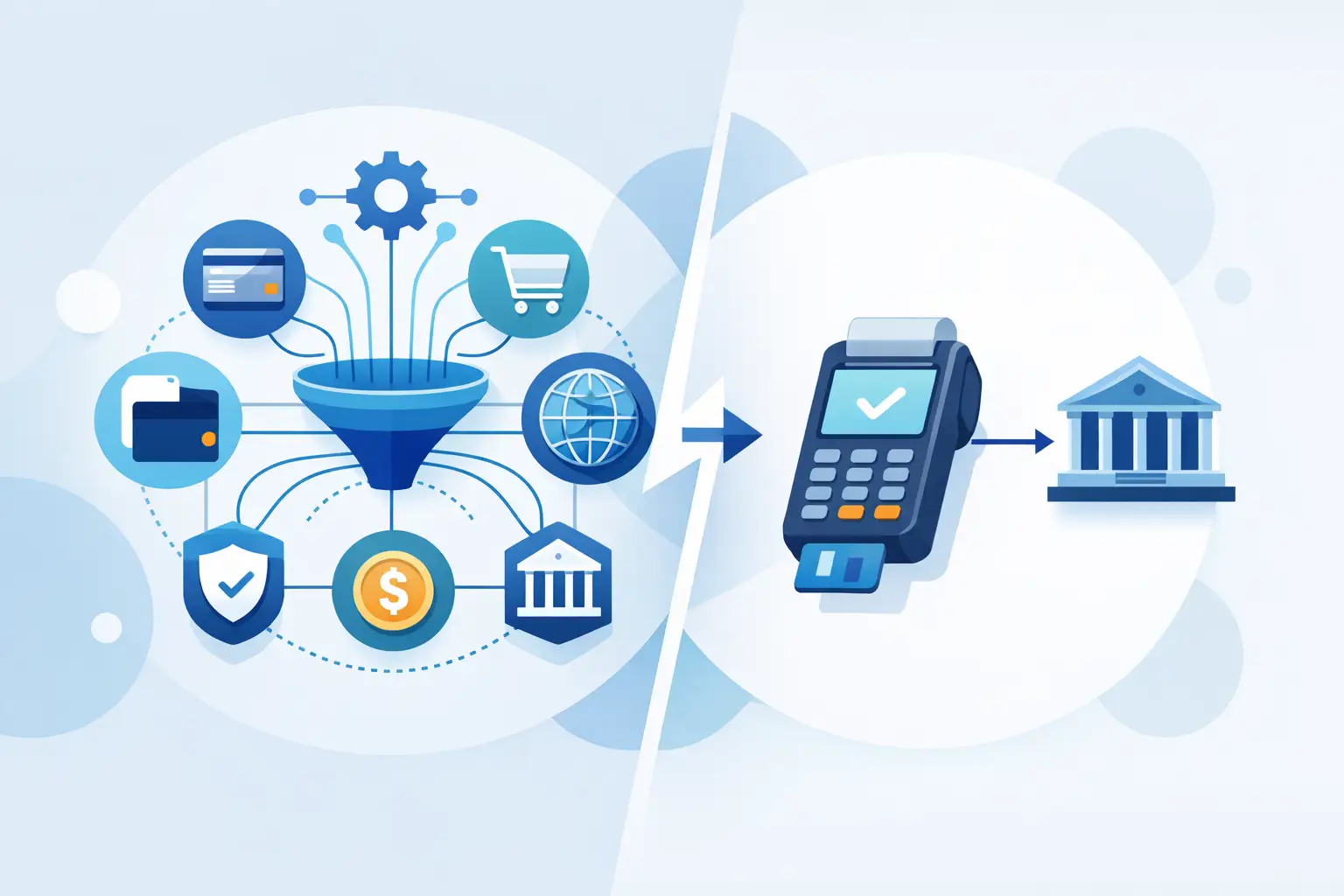
A payment decline during a major sportsbook event, crypto market swing, or peak retail campaign is rarely just a checkout problem. It can be a routing problem, an acquirer problem, a fraud-rule problem, or an operations problem hidden behind a single provider integration. That is the commercial distinction behind payment orchestration versus gateway: one primarily connects a business to payment processing, while the other coordinates a broader payments estate to protect conversion, control risk, and maintain continuity.
For high-volume and high-risk businesses, the choice is not academic. It affects approval rates, geographic expansion, settlement visibility, merchant onboarding, and how quickly teams can act when a provider degrades. A gateway may be sufficient for a focused business with one market and one acquiring relationship. An orchestration layer becomes more relevant as payment methods, providers, entities, and operational requirements multiply.
What a Payment Gateway Does
A payment gateway securely carries payment data between the customer, merchant, processor, acquirer, and card network or local payment rail. At checkout, it captures payment details, applies basic transaction handling, and sends the authorization request to the connected processing partner.
This is essential infrastructure. A gateway can provide hosted payment pages, tokenization, API access, recurring billing support, fraud-screening integrations, and support for cards or selected alternative payment methods. For a merchant operating in a limited number of markets, a gateway can reduce the complexity of connecting directly to each processor.
The limitation is architectural. A conventional gateway often operates around a primary processing relationship. If that acquirer declines more transactions than expected, encounters downtime, cannot support a local method, or becomes commercially uncompetitive in a market, the merchant may need to build, test, and deploy additional integrations before it can respond effectively.
That dependency is manageable at low complexity. It becomes expensive when a business accepts multiple currencies, serves several jurisdictions, operates high-risk merchant categories, or needs distinct routing rules by customer profile, payment method, issuer, and transaction value.
What Payment Orchestration Adds
Payment orchestration sits above gateways, processors, acquirers, fraud tools, and payment methods. It provides a control layer that can connect multiple providers through one integration and make real-time decisions about how each transaction should be handled.
The core value is not simply having more connections. It is the ability to use those connections intentionally. An orchestration platform can route a transaction to the provider most likely to approve it based on factors such as card BIN, issuer country, currency, merchant category, transaction amount, historical performance, and current provider availability.
For example, a card payment from a Brazilian issuer may perform better through one acquiring route, while a European wallet transaction may require a different local partner. A high-value deposit from a known customer may follow a different fraud and routing path than a first-time transaction from a higher-risk device. These decisions should happen in milliseconds, without forcing product teams to rebuild checkout logic for every provider change.
Orchestration also centralizes the operational layer around payments. This can include provider performance monitoring, intelligent retries, token management, cascading, reconciliation support, payout and settlement workflows, merchant configuration, reporting, and role-based controls. The precise scope varies by platform, so buyers should verify whether a vendor provides true operational infrastructure or only a routing API.
Payment Orchestration Versus Gateway: The Practical Difference
The simplest distinction is this: a gateway moves a payment request, while orchestration decides where, when, and under what rules that request should move.
A gateway is often a point connection. Payment orchestration is a decision and control layer across many point connections. Both may exist in the same architecture. In fact, orchestration frequently uses gateways and processors as downstream endpoints rather than replacing every gateway function outright.
The business implications are material. With a single gateway setup, an operations team may discover declining approval rates only after revenue drops. With orchestration, the team can monitor provider performance by market and automatically divert eligible traffic when predefined thresholds are breached. With a single connection, adding a local bank-transfer method can require a separate project. With a unified orchestration environment, that method can be configured alongside cards, wallets, and crypto under the same merchant and reporting structure.
This does not mean orchestration guarantees higher approval rates. Approval depends on issuer behavior, acquirer quality, data quality, fraud controls, customer experience, and regulatory requirements. What orchestration provides is more levers to measure, test, and improve performance instead of accepting the outcome from one route.
Where a Gateway Is Enough
A payment gateway remains the right commercial choice in specific situations. A business may not need an orchestration layer if it has one legal entity, limited geographic coverage, a small payment-method mix, predictable volume, and a strong processor relationship. In that case, additional infrastructure can create unnecessary cost and configuration work.
It may also be sensible to begin with a gateway when the immediate objective is a fast, simple launch rather than multi-provider optimization. The key is to avoid treating that initial choice as a permanent architecture. Payment requirements can change quickly after expansion into new markets, new verticals, or higher transaction volumes.
The warning signs are operational rather than theoretical: frequent provider incidents, manual reconciliation across systems, approval-rate variance by country, repeated integration projects, weak visibility into chargebacks, or an inability to offer local methods without rebuilding checkout. These are signals that the payment stack has outgrown a single gateway relationship.
Why High-Risk Businesses Need More Control
iGaming, forex, crypto, and high-volume digital commerce face payment conditions that standard gateway models do not always handle well. Customer behavior can be volatile. Payment-method preferences differ sharply by market. Chargebacks require evidence, speed, and consistent process. Providers can impose changing risk limits or reserve requirements, while fraud patterns move across brands and regions.
In these environments, routing is inseparable from risk management. Sending all traffic to the same provider can concentrate exposure and make a business vulnerable to one provider's underwriting decision, outage, or rule change. A multi-provider architecture spreads that dependency, but only if the business can govern it from one operating environment.
A mature orchestration setup can apply rules that balance conversion and risk. It can send transactions above certain thresholds through enhanced screening, restrict retry behavior to prevent excessive authorization attempts, apply provider-specific limits, and prioritize routes with stronger results for a particular market. It can also support chargeback workflows with transaction-level data, consistent reason-code handling, and shared fraud intelligence where available.
For payment firms and merchant aggregators, white-label capability adds another requirement. They need to manage merchants, pricing, provider access, settlement logic, and branded customer experiences without exposing a patchwork of underlying vendors. The infrastructure must be deployable as a product, not merely consumed as a merchant tool.
What to Evaluate Before Choosing
The right question is not whether orchestration sounds more advanced. It is whether the platform provides control over the constraints currently limiting revenue or expansion. Evaluate the provider model, not just the number of available integrations.
Look closely at these areas:
- Routing depth: Can rules use issuer data, geography, payment method, amount, merchant, risk signals, and live provider performance? Can business teams configure rules without an engineering release?
- Payment coverage: Are the relevant cards, local bank rails, wallets, alternative methods, and crypto options available in the markets that matter to your business?
- Operational control: Does the platform unify transaction search, reconciliation, settlements, disputes, provider reporting, merchant management, and access controls?
- Reliability and ownership: How are failover, monitoring, data retention, token portability, and incident response handled? What happens if a provider connection fails?
- Risk capability: Can the system support velocity controls, fraud-tool integrations, 3DS strategies, chargeback prevention, and vertical-specific risk rules?
Technical leaders should also assess implementation reality. A clean API matters, but so do webhooks, idempotency, token vault design, observability, sandbox quality, uptime commitments, and data export. Commercial teams should test whether routing logic can reflect actual provider contracts and settlement arrangements. A platform that looks flexible in a demo but requires vendor intervention for every rule change will slow down operations.
Build, Buy, or Deploy White-Label Infrastructure
Some large payment companies choose to build orchestration internally. That can make sense when they have deep engineering capacity, direct provider relationships, and the resources to operate a payments platform as a core product. The ongoing workload is substantial: integrations change, fraud patterns evolve, reconciliation exceptions accumulate, and regional payment requirements do not stand still.
Buying or deploying white-label infrastructure shortens that path. ZepoPay, for example, is designed for payment businesses and operators that need a branded platform with 75+ provider connections and 250+ payment methods, while retaining control over merchant operations, routing, settlements, and risk workflows. The strategic benefit is speed without surrendering the operating model to a generic checkout product.
The best architecture is the one that matches the business you are building next, not only the transaction volume you process today. If provider choice, approval performance, risk exposure, and regional expansion are board-level concerns, payments need a control layer built to make those variables manageable.