Payment Gateway Automatic Failover That Protects Revenue
Payment gateway automatic failover protects approvals, revenue, and customer trust by rerouting transactions when providers or rails fail under pressure.
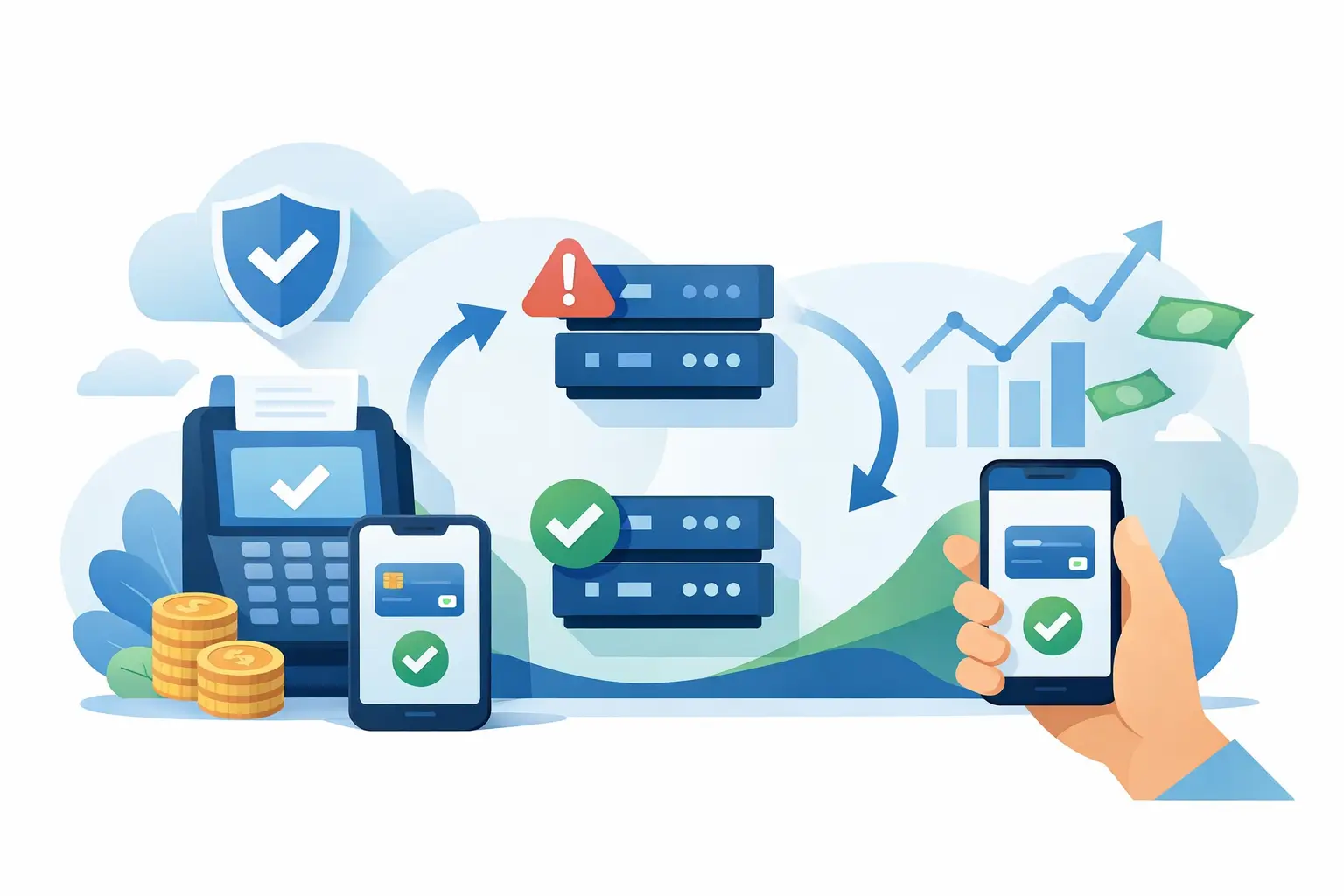
A processor outage during a peak sportsbook event, casino promotion, crypto market move, or retail launch is not a minor technical incident. It is a direct interruption to deposits, purchases, conversion, and customer confidence. Payment gateway automatic failover gives payment teams a way to keep accepting transactions when a provider, acquirer, payment rail, or regional route becomes unavailable or materially underperforms.
The distinction matters: a second provider is not failover by itself. A business can maintain five PSP relationships and still lose revenue if its team must detect the issue, change routing rules manually, and wait for a deployment while customers abandon checkout. Automatic failover turns provider redundancy into an operational control. It detects defined failure conditions and redirects eligible payment traffic to a viable alternative without asking the customer to start over.
For high-volume and high-risk businesses, the objective is not simply uptime. It is to preserve approval rates while protecting customer experience, fraud controls, reconciliation integrity, and commercial margins.
What Payment Gateway Automatic Failover Actually Does
Payment gateway automatic failover is an orchestration capability that shifts a transaction, or a defined segment of traffic, from a failing route to another approved route. A route may include a PSP, acquirer, merchant identification number, card scheme connection, local payment method, currency corridor, or processing region.
The platform evaluates transaction context and route performance in real time. If a primary route crosses a configured threshold - such as connection errors, timeout rates, elevated technical declines, or response latency - traffic can move to a secondary route. The rules should account for the payment method, issuer country, card BIN, currency, merchant vertical, transaction amount, and risk score rather than treating every payment identically.
A card authorization from a U.S. issuer may need a different fallback path than a bank transfer in Brazil or an e-wallet deposit in Southeast Asia. A high-value crypto purchase may also require a different risk sequence than a low-value e-commerce order. Effective failover operates at this level of precision.
Failover can be immediate for hard outages, but not every performance issue warrants a complete traffic switch. A provider with a temporary latency spike may still be the highest-converting option for a specific issuer range. That is why sophisticated routing uses both health signals and commercial performance signals. The correct decision is often to divert only the affected cohort, not to send all traffic elsewhere.
Why Failover Is a Revenue and Risk Control
Payment interruptions create losses that compound quickly. The first loss is the transaction that does not complete. The second is the customer who tries another operator, exchange, broker, or store. The third is the operational load created when support teams, finance teams, and payment managers must explain inconsistent transaction states.
In iGaming, deposit continuity is especially sensitive. A failed deposit can remove a player from a live event or game session at the moment intent is highest. In forex and crypto, market volatility can make a few minutes of payment unavailability commercially significant. For merchant aggregators, a single provider outage can affect many sub-merchants at once and damage the value of the entire payment offering.
Automatic failover reduces single-provider dependency, but it must not become uncontrolled transaction duplication. If a customer receives a timeout from the first acquirer, the payment may still be processing in the background. Sending the same authorization blindly to another acquirer can result in duplicate holds, duplicate captures, complaints, and chargebacks.
The failover engine therefore needs clear transaction-state management. It should distinguish a confirmed decline from a timeout, a connection failure from an issuer decline, and a completed authorization from an unknown state. Idempotency controls, unique transaction references, provider response normalization, and auditable routing logs are core requirements, not secondary engineering details.
Build Routing Rules Around Payment Outcomes
A useful failover configuration starts with a simple question: what condition should trigger a route change, and for which traffic? The answer should be based on measurable evidence rather than a generic rule such as “move everything after three errors.”
Hard triggers typically include provider unavailability, API connection failures, repeated gateway errors, and extended response timeouts. These conditions can justify fast route removal because they point to a technical issue rather than normal issuer behavior.
Soft triggers require more care. A rising decline rate can signal an acquirer problem, but it can also reflect changes in customer quality, a fraud attack, issuer behavior, or a promotion attracting lower-intent traffic. Routing all declines to another provider may increase authorization attempts, increase costs, and create negative network signals. The better approach is to classify decline codes and move only the traffic that is likely to benefit from a different route.
For example, insufficient funds should rarely trigger a retry through another acquirer. A suspected technical decline, issuer unavailable response, or acquirer-format issue may justify a controlled retry. Do-not-honor responses sit in the middle. Whether they should be retried depends on the scheme rules, issuer patterns, vertical, transaction value, risk profile, and acquirer strategy.
This is where payment orchestration creates an advantage over a basic gateway switch. It can apply rules such as sending a specific card BIN range to Acquirer B only when Acquirer A’s technical approval rate falls below a defined baseline, while retaining the original route for unaffected issuers.
The Architecture Behind Reliable Failover
Automatic failover needs dependable infrastructure beneath the routing logic. Health checks must be frequent enough to identify incidents early, but intelligent enough not to react to a short-lived anomaly. A system that flips providers too aggressively creates route flapping, where traffic repeatedly moves between processors and produces unpredictable results.
A strong architecture uses several signals at once: availability, latency, technical error rate, authorization rate by segment, callback delivery, and settlement or capture status. It also applies a recovery threshold before restoring a route. A provider should demonstrate sustained healthy performance before receiving its normal share of traffic again.
At the transaction layer, asynchronous processing must be handled carefully. Many payment methods do not return a final outcome in the initial API response. Bank transfers, local methods, wallets, and some 3DS flows may rely on webhooks or customer redirects. The orchestration layer needs a durable event model so a delayed confirmation from the original provider does not conflict with a fallback attempt.
Token strategy also affects failover coverage. If card tokens are locked to one provider, moving a customer to another acquirer may require fresh card entry or a separate token vault arrangement. Network tokens, portable vaulting, and properly governed token migration can reduce this friction, but each option carries commercial, security, and compliance considerations.
A modern white-label platform should expose routing configuration through controlled merchant operations tools rather than requiring engineering intervention for every adjustment. Teams need role-based access, approval workflows, versioned rules, test environments, and a full audit trail. In a regulated or high-risk operation, no one should be guessing why a transaction was sent to a particular provider.
Failover Must Respect Fraud and Compliance Logic
More approvals are not automatically better approvals. A route change can alter fraud scores, 3DS behavior, device data availability, velocity controls, and acceptance rules. If failover bypasses the risk layer, it can convert a processor incident into a fraud-loss event.
The risk engine should remain consistent across routes wherever possible. Device fingerprinting, behavioral signals, shared fraud intelligence, blacklist decisions, velocity limits, and player or customer history should travel with the transaction decision. For iGaming operators, this is particularly relevant when deposits, bonus abuse, account takeover, and chargeback exposure are connected.
Compliance logic must also be route-aware. Certain providers may support particular countries, merchant categories, currencies, or payment methods under different terms. Fallback routing cannot send traffic to a technically available provider that is not authorized to process that transaction type. The best rules combine availability with eligibility and risk acceptance.
How to Test Payment Gateway Automatic Failover
Failover that has not been tested is only a configuration assumption. Payment teams should run controlled failure scenarios before peak traffic periods and after major provider, API, or routing-rule changes.
Test cases should cover full provider downtime, partial API degradation, callback delays, elevated technical declines, 3DS failures, duplicate-request prevention, and recovery behavior. Teams should confirm not only that the fallback route approves transactions, but also that customer messaging, reporting, reconciliation, settlement, and support tooling show a coherent transaction history.
Measure the impact by segment. Track approval rate, processing latency, retry rate, duplicate attempt rate, fraud rate, chargeback rate, cost per approved transaction, and customer abandonment before, during, and after the route change. A failover decision that saves approvals but sharply increases fraud or processing expense needs refinement.
ZepoPay's multi-provider payment infrastructure is designed for this operational model: centralized routing across 75+ providers and 250+ payment methods, with the controls required to manage traffic at scale under a merchant's own brand. The value is not merely having more connections. It is being able to govern them from one operating environment.
The strongest payment teams treat failover as a living performance program. They review provider behavior by market and payment method, tune thresholds after real incidents, test recovery paths, and keep risk rules aligned with routing logic. When the next provider disruption arrives, the goal is simple: customers keep paying while your team stays in control.