Ecommerce Checkout Recovery That Protects Revenue
Ecommerce checkout recovery turns failed payment attempts into approved orders with smarter routing, retries, payment options, and risk controls at scale.

A payment failure at checkout is not always a lost customer. It is often an unresolved transaction state: an issuer timeout, a soft decline, an expired credential, a blocked cross-border route, or a customer who could not find the payment method they trust. Ecommerce checkout recovery is the operating discipline of identifying those states quickly and giving legitimate buyers a better path to pay without increasing fraud, chargebacks, or support volume.
For high-volume merchants and payment operators, recovery cannot be reduced to a single abandoned-cart email. The highest-value failures occur inside the payment flow, where authorization logic, provider performance, local payment coverage, authentication, and risk policy determine whether an order is approved or disappears. The difference between a basic checkout and a recovery-capable payment operation is control over what happens after the first attempt fails.
Why Checkout Failures Need Operational Treatment
A failed payment is not one event. It is a collection of failure reasons with very different recovery potential. Treating every decline the same creates two expensive outcomes: legitimate customers are rejected unnecessarily, while high-risk attempts receive more chances than they should.
Hard declines usually require a different action than soft declines. A card reported lost or stolen, an invalid account number, or a fraud-block decision should not trigger aggressive retries. By contrast, insufficient funds, issuer unavailability, velocity limits, temporary technical errors, and some authentication failures may be recoverable through a timed retry, a different processor, or an alternative payment method.
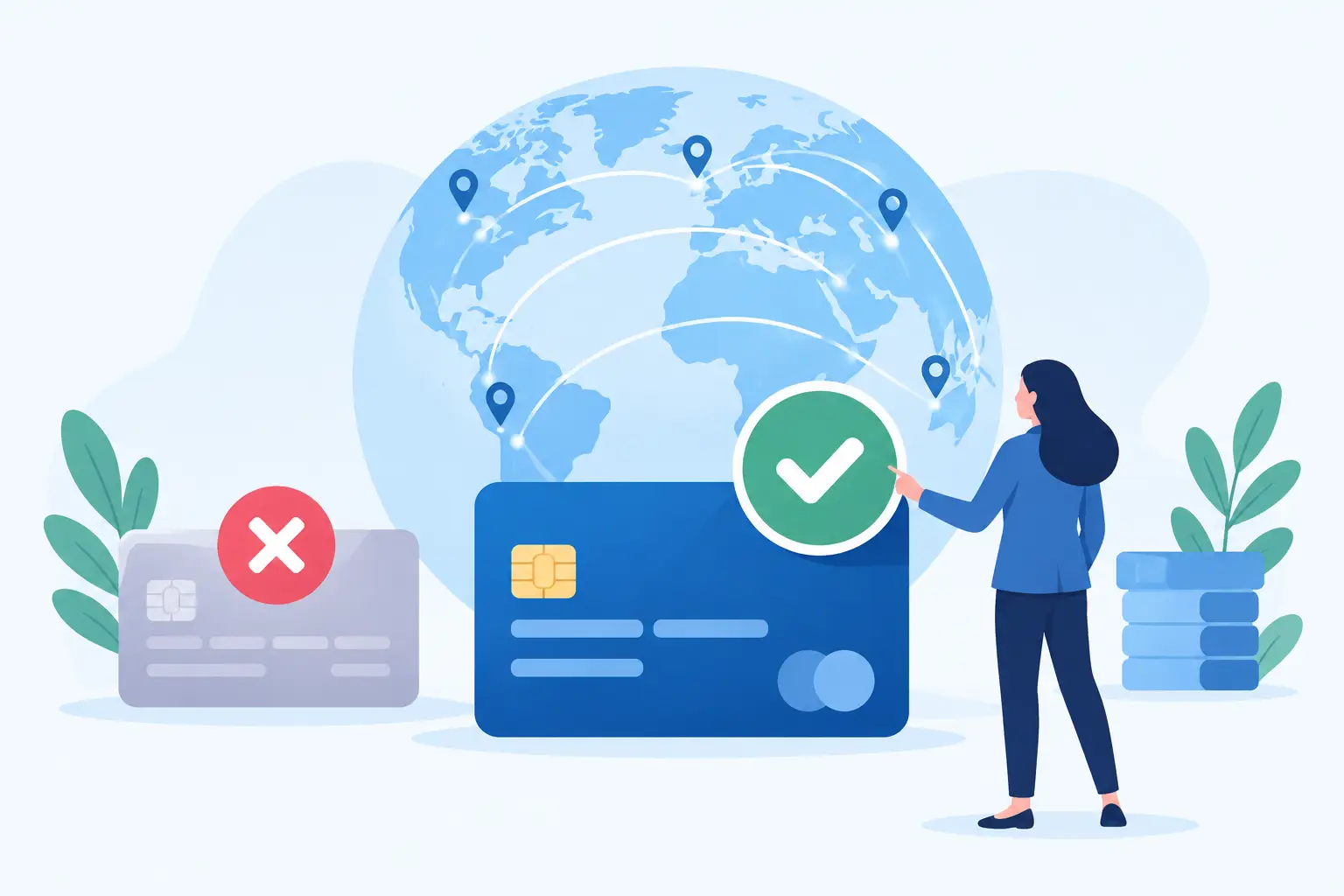
That distinction matters most in international ecommerce. A customer in one market may expect a bank transfer, mobile wallet, or local voucher method rather than an international card. A transaction may fail because the selected acquirer has weak issuer connectivity in that country, even though another route would approve it. Recovery therefore starts with payment intelligence, not messaging.
Measure the Failure States That Affect Revenue
Operations teams need a view beyond a headline authorization rate. The useful question is: which failure types are concentrated by provider, issuer country, card scheme, payment method, merchant category, currency, and time window?
For example, a sudden increase in issuer timeouts on one processing route calls for routing intervention, not a customer-facing campaign. A rise in 3DS abandonment may point to an authentication UX issue, a mobile browser compatibility problem, or excessive challenge rates. A cluster of insufficient-funds declines may justify one carefully timed retry, while a rise in fraud declines requires a review of risk thresholds and traffic quality.
Recovery reporting should separate initial approval rate, recovered approval rate, final approval rate, false-decline indicators, and post-recovery fraud outcomes. If a strategy improves approvals but raises disputes three months later, it has not protected revenue. It has moved the loss downstream.
The Ecommerce Checkout Recovery Control Layer
Effective recovery combines real-time payment orchestration with customer-facing fallbacks. The transaction should be classified as it happens, then handled according to its reason code, risk profile, payment context, and available routes.
Route Before You Retry
The best recovery action can occur before the customer sees a failure message. Smart routing evaluates which provider, acquirer, or payment rail is most likely to approve a transaction based on issuer geography, currency, card type, historical approval patterns, cost, and risk signals.
If the preferred route returns a technical failure or a recoverable soft decline, an orchestration layer can decide whether a secondary route is appropriate. This decision must be tightly controlled. Blind cascading across multiple processors can create duplicate authorization holds, confuse customers, increase processing costs, and look like suspicious retry behavior to issuers.
A practical routing policy sets limits by transaction type and risk tier. A low-risk repeat customer may qualify for a controlled alternate route after a timeout. A first-time cross-border buyer with mismatched device and billing signals may require step-up authentication or a different payment option instead. Recovery should improve legitimate conversion, not bypass risk controls.
Use Intelligent Retries, Not Repeated Attempts
Retry timing is one of the most mismanaged areas in checkout performance. Retrying immediately after a temporary issuer decline can sometimes work. Repeating the same attempt several times in seconds usually does not. It can lower issuer trust, create support tickets, and result in duplicate pending charges.
A recovery engine should use decline codes and payment context to determine whether a retry is allowed, how long to wait, and whether to alter the route. It should also stop when the reason indicates that another attempt is unlikely to succeed.
For subscription and repeat-purchase models, scheduled retries can be especially valuable. The optimal cadence depends on customer behavior, market, payment method, and average order value. A short retry window may suit a low-ticket digital purchase. A higher-value transaction may benefit from a clearer customer prompt and a longer period to update the payment method. The core rule is simple: retries need a reason, a cap, and an audit trail.
Present the Right Alternative Payment Method
Customers do not abandon only because their cards are declined. They abandon when the checkout does not offer a viable next step. If a card attempt fails, the recovery screen should offer relevant alternatives rather than a generic error and a blank retry button.
The right option depends on location and customer preference. Bank transfers, account-to-account payments, mobile wallets, local card schemes, cash-based methods, and crypto payments can all recover transactions that a single card flow would lose. Presenting every available method at once, however, can create decision friction. Payment methods should be prioritized by market relevance, historical conversion, order value, and customer segment.
A globally scaled operation needs broad method coverage and the ability to manage it centrally. Supporting 250+ payment methods is only commercially useful when the checkout can expose the right methods to the right buyer, while keeping settlement, reconciliation, and customer support manageable.
Customer Messaging Is Part of Recovery
Payment error messages are often written for developers, not buyers. “Transaction declined” gives customers no usable path forward. It can also make a legitimate buyer feel accused of fraud.
The message should acknowledge the issue without disclosing sensitive risk logic. A useful recovery prompt can ask the customer to try a different payment method, confirm details, complete authentication, or contact their bank when appropriate. The language should be specific enough to guide action but neutral enough to protect fraud controls.
For logged-in customers, recovery can continue after checkout through a secure payment link, account notification, or saved-cart experience. This works best when the follow-up reflects the actual failure reason. Sending a broad “you left something behind” message after an issuer decline misses the opportunity to offer an alternative method or a fresh authorization attempt.
Do not use post-checkout messaging to pressure every failed payer. High-risk attempts, suspected card testing, and transactions that failed definitive fraud checks should exit the customer recovery flow and enter the risk workflow instead.
Protect Recovery From Fraud and Chargebacks
A higher approval rate is not automatically a healthier payment operation. Fraudsters test recovery logic too. They may rotate cards, exploit repeated routing attempts, probe payment method availability, or use compromised credentials that initially appear legitimate.
Recovery policies need to work with fraud rules, device intelligence, velocity monitoring, behavioral signals, and shared fraud data. Each additional attempt should be evaluated against the latest available information, not treated as a disconnected event. This is particularly important for high-risk verticals, where chargeback exposure can erase the margin gained from recovered approvals.
Set explicit guardrails: maximum retry counts, route restrictions by risk score, duplicate-payment detection, limits on payment-method switching, and review triggers for unusual patterns. Teams should also monitor whether recovered orders produce disproportionately high refunds, disputes, or manual-review rates. That feedback loop keeps recovery aligned with profitable growth.
Build Recovery Into the Payment Stack
Ecommerce checkout recovery becomes difficult when payment providers, fraud tools, merchant systems, and reconciliation data operate in separate environments. Teams lose visibility into the original failure, the retry path, the final settlement state, and the customer communication that followed.
A unified payment operations environment gives product, risk, and finance teams a shared transaction record. It can connect 75+ providers through a single API, apply routing rules consistently, expose real-time status updates, and make recovery performance measurable across merchants and markets. The objective is not more payment complexity. It is centralized control over complexity that already exists.
For PSPs, merchant aggregators, and ecommerce platforms, white-label infrastructure adds another advantage: recovery rules, checkout behavior, and reporting can be deployed under the operator's own brand and commercial model. ZepoPay is designed for this type of multi-provider operation, combining payment orchestration, merchant controls, risk tooling, and settlement workflows in one deployable environment.
The most useful closing question is not how many carts were abandoned. It is which legitimate payment attempts failed, why they failed, and whether your payment stack gave those customers a safe, relevant way to complete the order.